Back from JALT2026 in Nagoya: Reflections, Catch-Ups, and Looking Beyond the AI Hype

I’ve just returned from the JALT2026 International Conference in Nagoya, and one thing was noticeably different this time: I couldn’t walk ten feet without running into a familiar face from Nagoya, Kyushu, or previous conferences. For a bit of an introvert, it was reassuring to see that my extremely slow-and-steady networking process is finally starting to pay off.
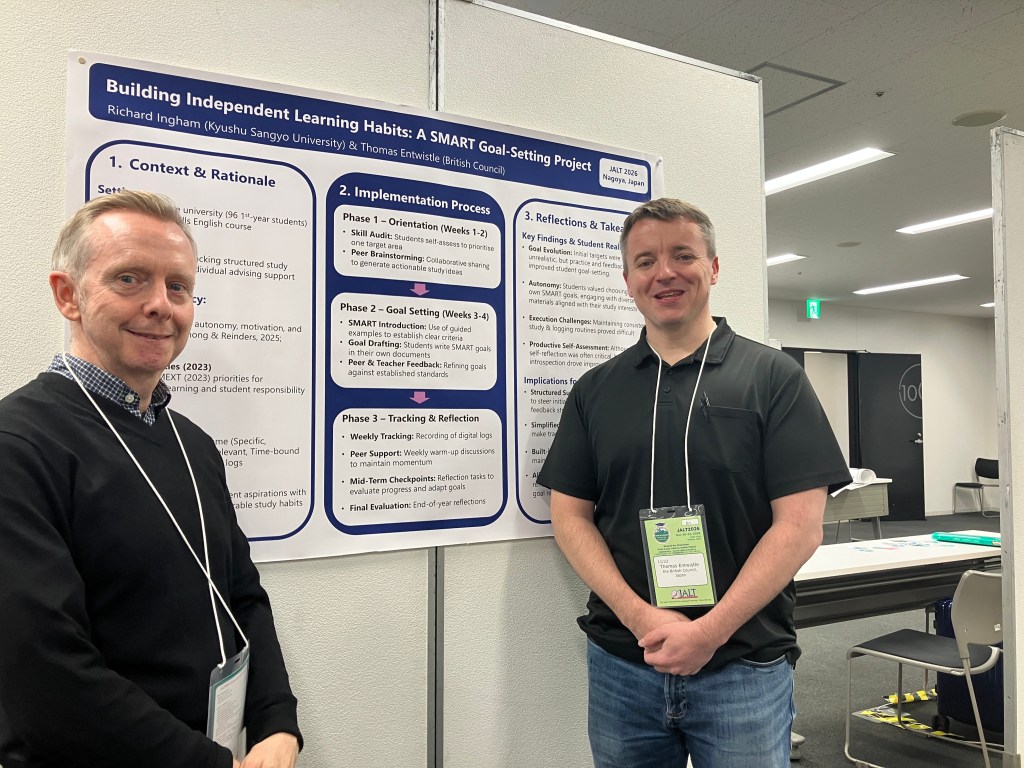
On Sunday afternoon, I teamed up with Tom to present a poster in the Learner Development SIG Forum titled “Building Independent Learning Habits: A SMART Goal-Setting Project”. It was rewarding to share how structured goal-setting and regular reflection can help university students take more ownership of their English study, and the conversations around our poster gave me plenty to think about with regard to possibly adapting these ideas to a new teaching context.

Going into the weekend, I was hoping to find plenty of sessions on extensive reading, learner autonomy and vocabulary learning. While those presentations seemed a little thinner on the ground this year, there were still enough to get stuck into. In particular Charles Brown’s presentation about using corpus tools like the NGSL to better match vocabulary load to learner levels might be of use in my TOEIC classes.

If I have one critique of the program, it’s that AI presentations felt inescapable. I generally avoided these as I found them to be a little repetitive, although I did attend a thought-provoking session on digital neocolonialism and the hidden costs of uncritical tech adoption. That said, catching up with old contacts sparked some interesting ideas for tech collaboration. A couple of people were interested in vibe coded apps (see previous post) that I have been using to support learner choice, so we’ll see if something comes of that.

All in all, it was a worthwhile trip: a bit heavy on the AI buzzwords, perhaps, but full of good company and fresh directions for the future.

Using SMART goals with first-year students in Japan

Last academic year, I introduced a SMART goal-setting project into my first-year English classes at a university in Japan.

Many of the students were highly motivated, with goals to travel, study abroad, and communicate with people from other countries. But when asked how they planned to improve, their answers were often vague: “study vocabulary”, “become fluent”, “practice speaking”.

The aim of the SMART goal-setting project was to give them some structure.

Students set a personal SMART goal (Specific, Measurable, Achievable, Relevant, Time-bound), tracked their progress in a shared document, and reflected on their learning at the middle and end of both semesters.

It became clear relatively quickly that motivation did not necessarily translate into action. At the start, most students were positive about setting goals, but maintaining consistent effort was much harder. Some students followed through, but many struggled to build regular study habits. As one student put it: “Actually, I was lazy. I played games instead of studying.”

One of the major issues was time management. As the semester progressed, students were dealing with assignments from other classes, part-time jobs, and extracurricular activities. In that context, independent study was often pushed aside. Goals that worked best tended to be small and flexible. For example, watching short videos or using vocabulary apps during spare moments was more sustainable than larger plans.

Reflection on their achievements was another challenge. Although many students did some kind of English study, they did not always record it. Logs were often left incomplete or written just before deadlines. This suggests that reflective practices do not come naturally to many students and need to be taught and supported more explicitly.

Despite this, there were also some clear positives. When students chose their own activities, they explored a wide range of options: YouTube, podcasts, apps, test preparation materials, and even using English at part-time jobs. Some adjusted their goals during the semester, suggesting a growing awareness of what worked for them. A number of students engaged consistently with the project, logged their activities in detail, and were able to see clear improvement in their language ability.

One clear takeaway is that learner autonomy does not develop on its own. Even setting a useful goal requires support and feedback, as students need help making their goals specific, realistic, and manageable. Ongoing support is also important to help students stay on track.

Despite my initial hopes, the project did not transform students into fully independent learners. However, it did encourage them to identify areas they want to improve and to think more carefully about how they study and what they are trying to achieve. Overall, this feels like a useful starting point.

If I run something similar again, I would:

  • provide more support when students first write their goals
  • show clearer examples of effective reflection
  • encourage smaller goals that fit into daily routines

Even small adjustments like these may help students turn good intentions into more consistent action