Unlike many people, I’d never really harboured any long term ambitions of writing a book. I tended to subscribe to Christopher Hitchens’ idea that “Everyone has a book inside them, which is exactly where I think it should, in most cases, remain”
Since starting work at university, however, I had become aware of the considerable benefits to language learning of extensive reading and had pushed hard for (and achieved) the adoption of extensive reading into some of the courses in my previous job.
My ex-coworker and I had talked several times about writing graded readers for our own library, but weren’t really sure where to begin. So, when the opportunity of the GRAPE (Graded Readers Authorship and Publication Experience) came up, we both felt that it was too good an opportunity to miss.
The GRAPE programme, organised by the JALT Materials Writers SIG, is a professional development initiative that supports participants in learning how to write and publish graded readers for language learners. Through workshops, mentoring, and feedback from experienced authors and editors, we were guided towards producing a book for the XReading extensive reading website.
My effort, a mystery story entitled “The Quiet Hero”, has just been published on the XReading website. It’s basically a mix of Detective Conan, Scooby-Doo and Star Wars, but let’s be honest, it’s mostly Scooby Doo.
Anyway, I am in the process of writing a more academic paper about my experiences that I will be sending off to a journal sometime soon.
In the meantime, please ask your students to read and review the book.
Yesterday, I attended the Fukuoka JALT – Busan-Gyeongsang-Daegu KOTESOL Joint Symposium hosted at Seinan Gakuin University. Under the theme of Collaboration Across Borders, it was a great day of professional sharing, insightful presentations, and connecting with colleagues from across Japan and Korea. Some of the highlights for me included:
Education Policy in Japan: Dr. Sunao Fukunaga’s plenary session offered a fascinating look at how MEXT English education policy plays out across different public high schools. It really drove home how different a policy looks in theory compared to how it actually plays out in practice.
Video Haikus: Ashley Ford-Mihashi’s presentation on using “Video Haiku” (5–7–5 second video structures) as part of the Reel Voices short film challenge demonstrated an engaging way to integrate visual digital composition with creative language production.
NNEST Legitimacy in Korea: Meerbek Kudaibergenov’s session on Non-Native English Speaking Teachers (NNESTs) in South Korea highlighted the systemic challenges and visa regulations prioritizing nationality over qualification. It was a candid and eye-opening discussion on identity, power, and hiring policies in ELT.
After the presentations concluded, we gathered at Nishijin Houten Shokudo for dinner to relax, catch up, and continue our conversations over good food.
A big thank you to the Fukuoka JALT and KOTESOL teams for organizing such a valuable cross-border event!
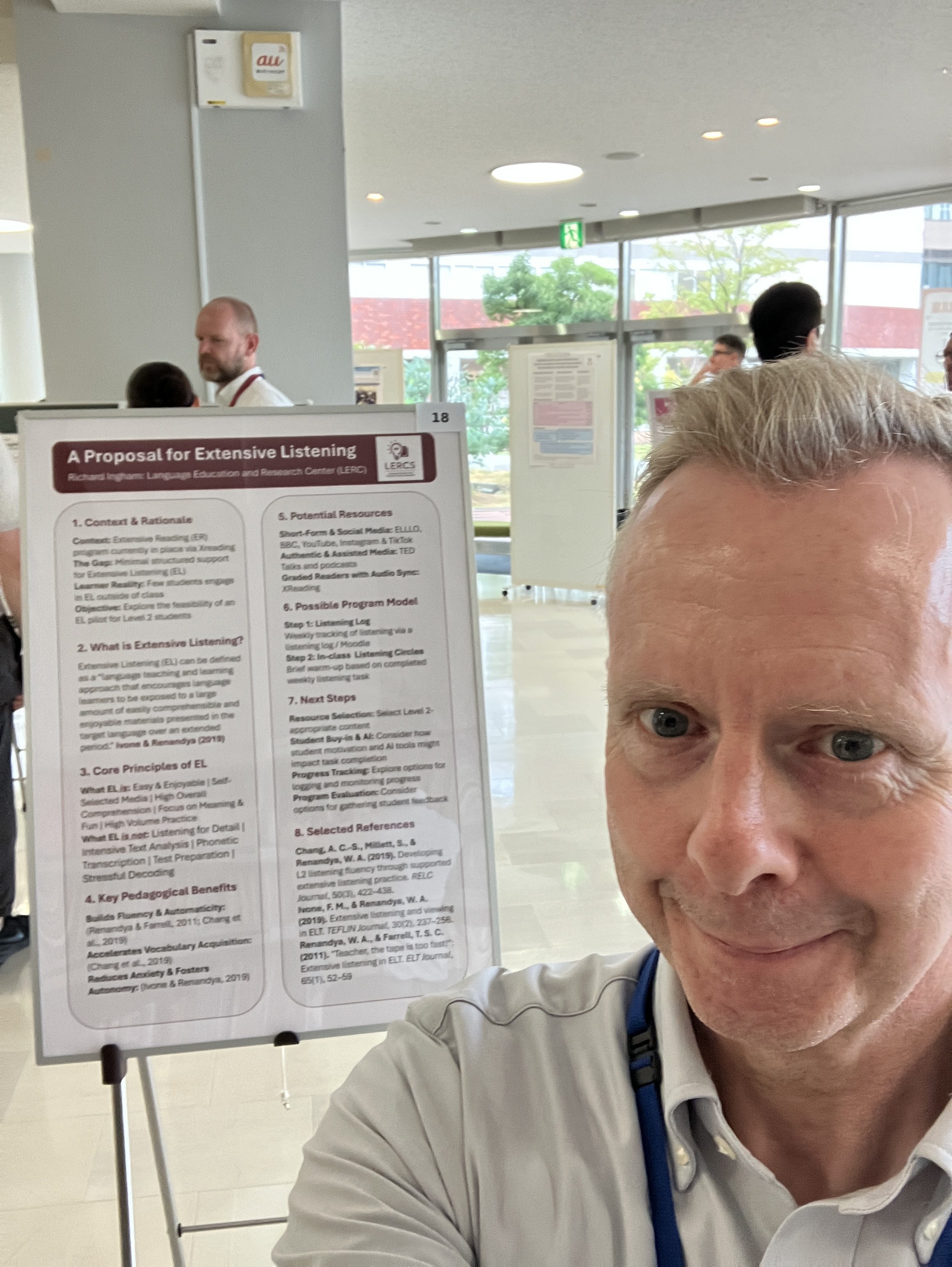
I recently gave a poster presentation at the KSU LERC Symposium outlining a proposal for a new Extensive Listening (EL) initiative. While our current Extensive Reading program via Xreading is well-established, there remains a noticeable gap in structured support for listening, with few students actively engaging in listening practice outside of class.
EL encourages learners to consume a massive amount of easily comprehensible and enjoyable target-language listening material over an extended period.
Unlike intensive listening (typically undertaken in class), EL is not about stressful decoding, phonetic transcription, or listening for minute details. Instead, the approach centers on enjoyment through self-selected media and high volume practice. Research shows a number of benefits for learners including the acceleration of vocabulary aquisition and a reduction in anxiety when listening
A potential way to implement this, is for students to choose from a variety of media e,g, BBC Learning English, ELLLO, YouTube, TikTok etc. (TED Talks, podcasts). The plan features two rather simple steps:
Listening Logs: Students track their weekly listening habits via Moodle or dedicated logs.
In-Class Listening Circles: Students discuss with classmates what they listened to / watched.
The next steps involve selecting appropriate content at the right level, securing student buy-in (particularly evaluating how AI tools might affect task completion (cheating!)), and working out the best way for students to track their progress.
Not sure if I can get everything in place by the start of the new semester next week, but I’ll give it a go.
In classes, I often find myself falling back on the same piece of advice: read more. It usually comes up when students ask how to improve their vocabulary or push their scores up on tests like TOEIC or TOEFL. I was really pleased to see that some courses at my new job include an extensive reading component (via Xreading), as I am a firm believer in the power of ER. What surprised me, though, was the sheer amount of avoidance and cheating that went on among the students. Yet, as irritating as that was to experience, it did force a bit of honest self-reflection: why don’t I follow my own advice when it comes to my Japanese learning and actually read a bit more? Here’s what I came up with.
Time and Energy
The issue of time is obvious, but is an important one for me. Since starting a new job, most of my attention has been taken up with getting used to new systems, preparing classes, and dealing with professional development. On top of that, I already spend a good deal of time reading for work, mostly academic papers. By the time I get home, the idea of picking up a Japanese book does not feel especially appealing. Whilst students are not in exactly the same situation, their schedules are not empty either. Between classes, assignments, and part-time work, they probably have a bit of a struggle finding time to do their reading.
The Screen Trap
Screen time is another major obstacle, and it affects me just as much as my students. While I manage to avoid the endless doomscrolling of TikTok or Instagram, I am far from immune to digital distractions. In the evenings, it is all too easy to give in to the tempting, dopamine-driven algorithm of YouTube instead of picking up a book. For students who have grown up entirely surrounded by short-form video and interactive media, sitting down with a plain page of text must require an even greater effort of concentration. When your brain is wired for instant hits, traditional reading must seem painfully slow by comparison.
Choice and Content
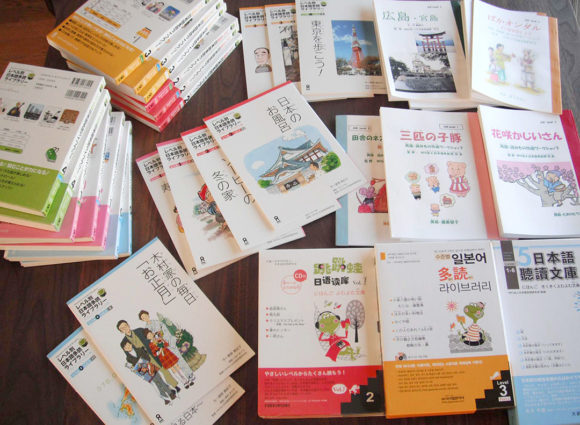
Finding material that genuinely interests me has been harder than I expected. In English, there is a massive range of graded readers covering everything from crime thrillers to simplified classics. With Japanese, the choices feel noticeably narrower. A lot of the material I come across leans towards folk tales, historical figures, or fairly safe informational topics. While there is nothing wrong with those, they are not things I would choose to read in my own language. There are some exceptions, though. For example, I remember enjoying a simplified version of Oscar Wilde’s The Happy Prince, and I recently bit the bullet and bought a subscription to Satori Reader because the content actually looked interesting. However, it does, of course mean more screen time.
Convenience and Physical Books
Access to graded reading materials is also something of an issue. Physical graded readers in Japanese are not always easy to source, yet I still prefer them over reading on a device. There is a tactile satisfaction in turning physical pages and seeing actual progress that a digital progress bar just cannot match. However, after spending most of my working day staring at a computer screen, switching to an e-reader or phone app for recreation feels uninviting, which leaves me stuck between hard-to-find paper books and eye-draining screens. Digital options like Satori Reader offer a great compromise on content quality, but overcoming that extra evening screen fatigue will no doubt be quite tough.
Cost
Financial investment plays a role here too. Graded readers are relatively expensive, especially given how quickly you read through them. Paying a high price for a thin book that might include outdated extras like companion CDs often feels like a poor return on investment, making it harder to justify building a personal library.
Initial Resistance
Beyond time, cost, or availability, there is the sheer friction of getting started. Even when I have a suitable text right in front of me, taking that first step takes more willpower than it should. It is always easier to push it off until tomorrow. The standard advice is familiar enough: keep sessions short, build a habit, and read a little every day. It is exactly what I tell my students, yet putting it into practice is a definite sticking point.
Where That Leaves Things
Thinking through these points has not changed my belief that reading is valuable, but it has made my own advice feel a bit less straightforward. If an English teacher who understands the theoretical benefits of Extensive Reading still struggles with time, screen distractions, content selection, and friction, it is hardly surprising that language learners struggle too. Closing the gap between recommending reading and actually doing it is where the real work lies. Let’s see how I get on with Satori Reader.
I often feel that if I had spent as much time actually studying Japanese as I have searching for some kind of magical silver bullet, I’d be fluent by now. If I’m being honest, it’s a form of procrastination. I have wasted countless hours reading blogs about SRS, the Heisig method, speed-running Kanji, and total immersion strategies like AJATT (All Japanese All The Time). You would think that as a language teacher, I’d have grasped the ultimate truth by now: the real secret is simply knuckling down and doing the work, not relentlessly consuming content about how to learn faster.
Over my years of teaching, I’ve come to the firm realization that real language progress happens away from the classroom, not just inside it. Because of this, I constantly urge my students to adopt extensive reading and listening habits on their own time. Of course, I say this while rather hypocritically failing to do it myself.
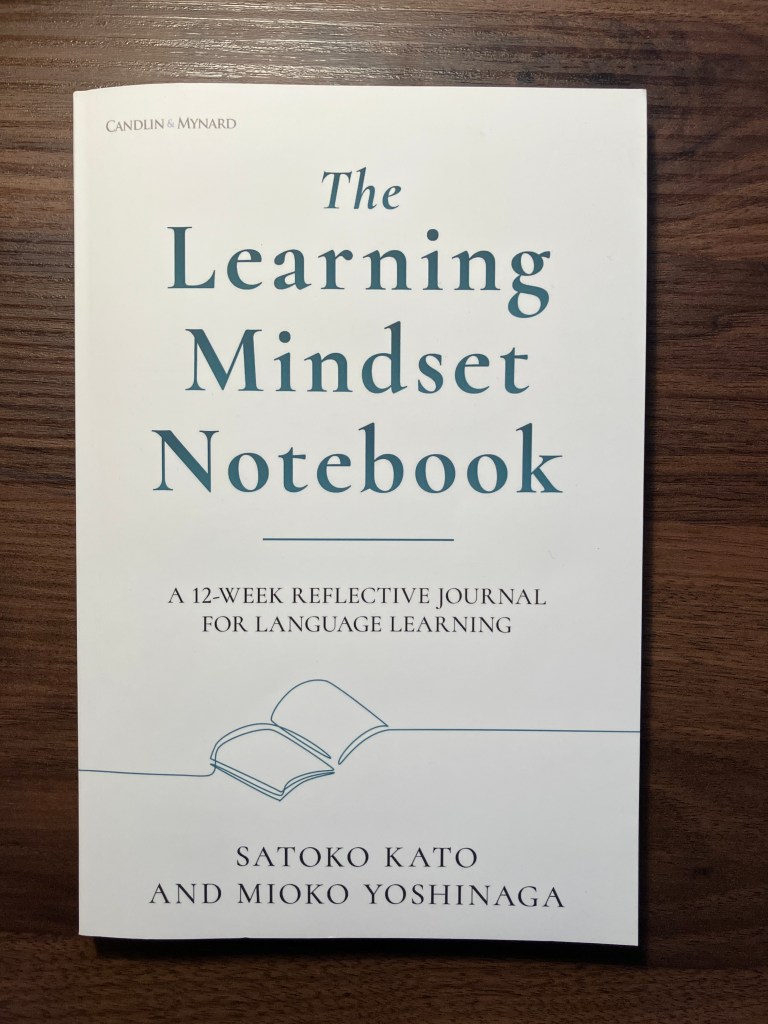
But recently, a book called The Learning Mindset Notebook caught my eye. The publishers describe it as a guided, hands-on companion for learners looking to take control of their own language journeys. It’s built around eight core principles designed to foster motivation, self-awareness, solid planning habits, and overall well-being. Ultimately, it promises to help learners bridge the gap between good intentions and sustained action. It sounded like exactly what I needed, so I ordered a copy.
I’m approaching this book from two different angles. First, as a language learner myself who has hit a frustrating plateau at the intermediate stage; and second, as an educator with an interest in learner autonomy and self-directed study.
So, I’ve been working my way through the exercises whilst simultaneously looking into the psychology behind them. My goal is two-fold: kickstart my own Japanese progress and draft a formal review for an academic journal down the line. I think it’s already paying off. Since opening the notebook, I’ve restarted my Japanese classes and finally feel like I am getting back on track after a long lay off from studying.
It’s been something of a week of TBLT (Task-Based Language Teaching) synchronicity. I’d noted in a previous blog my thoughts on the importance of tasks in my new context; then, a co-worker mentioned his use of TBLT, two related JALT pieces (an exposition by Rod Ellis and an interview with Shoko Sasayama) dropped through my analog mailbox, and I spotted an online seminar hosted by Tokyo JALT by Marcos Benavides of JF Oberlin University.
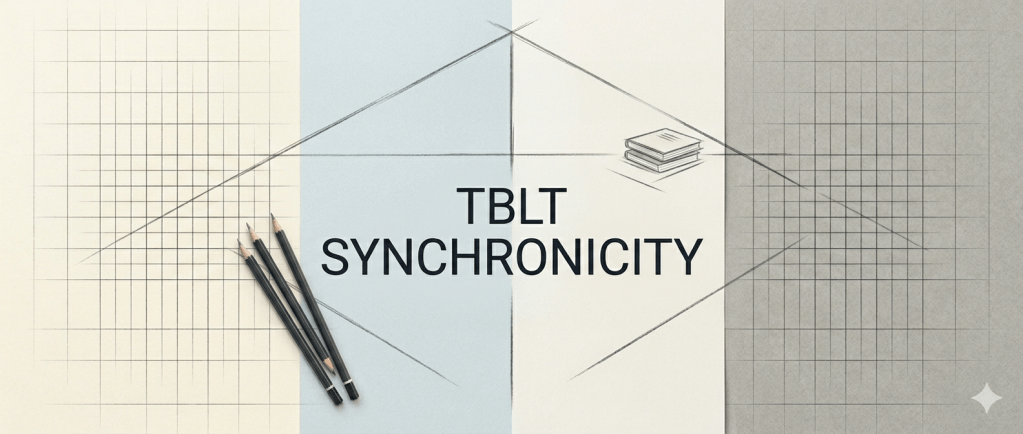
One of the most interesting things I got from this week’s festival of TBLT goodies was Benavides’s analogy of the artist. Traditional teaching is like a grid: we focus on one tiny square of grammar at a time, hoping the student eventually develops enough squares to produce a whole picture. It’s precise, but often demotivating because the “meaning” is buried. TBLT, by contrast, is more like a holistic sketch. From day one, the student draws the whole picture. It’s messy and imperfect, but it is meaningful from the start. As teachers, our job is to help the students gradually improve the whole image through feedback and repetition.
Although I have used “tasks” in the past to augment structured teaching, this was not pure TBLT, but rather Task-Supported Language Teaching (TSLT). The distinction has finally clicked. In TSLT, we teach the language forms first, which can trap students; they stop trying to communicate and focus too much on producing accurate forms. In “pure” TBLT, we let them use their own resources first. Watching Benavides’s videos of lower-level learners successfully navigating market research reports was fascinating. Whilst not perfect, they were effectively communicating their ideas.
The reality of teaching in a Japanese university means institutional structures and exams are often built on traditional foundations. However, I liked the advice from both Ellis and Benavides to keep the two approaches separate—a “Dual” or “Hybrid” approach. I think that this offers a practical window for my own professional development. By keeping a structural component and a task-based component distinct, I can wait for the right opportunities to experiment with “pure” TBLT when time (and energy) allows. I can see that this could help carve out a space for experimentation without going all out fo TBLT from the get go.
Final thought and key takeaways:
A Task must have a “Gap”: If there’s no information or opinion to exchange, it’s just an exercise.
Assessment follows Outcome: Did they achieve the goal? Accuracy of language is secondary to the communicative result.
Sequence by Complexity: Move from a simple task such as a short “elevator pitch” to a “formal presentation” and build learner confidence and fluency through repetition.
TBLT is a work in progress rather than a monolithic theory, requiring us as teacher-researchers to be flexible, experimental, and patient.
I recently started a new position, and after the first stretch of teaching, I wanted to note a few early thoughts. These are very much initial impressions, and I expect my understanding to develop over time as I settle in.
1. Adjusting to Different Proficiency Levels
One of the most immediate differences has been the overall proficiency level of students. At lower levels in particular, tasks require more careful setup and support. Activities are finished quite quickly, which means lessons need a greater number of shorter activities.
This has all kinds of implications for pacing and teacher energy. Lessons have felt quite intensive, with a need for sustained attention to scaffolding, modelling, and choral drilling. My voice took a bit of a battering during the first week or so and I got a pretty bad sore throat, from which I fortunately recovered fairly quickly.
2. Student Motivation and Classroom Behaviour
Since students are mostly enrolled in compulsory English classes, engagement can vary, and maintaining focus during activities requires consistent monitoring and encouragement. There is also a noticeable emphasis among some students on completing tasks efficiently. This occasionally comes at the expense of actually using English to complete tasks in communicative activities. It is necessary to consistently encourage and support the use of English to ensure students remain on task.
At lower levels, clarity of instruction is especially important. I have found a much greater need for ICQs (Instruction Checking Questions) to make sure the class know what they have to do. Even simple instructions can take time to process, and I have occasionally drawn on (my rather limited) Japanese to support understanding. This has helped maintain lesson flow, although I am aiming to balance this with maximising exposure to English.
3. Homework and Out-of-Class Learning
Students are assigned a substantial amount of homework, including e-learning components and vocabulary study. In practice, completion rates, particularly at lower levels, can be uneven. One approach that has been suggested is to allocate some class time for students to begin homework tasks. Whilst I am sure that this can help ensure engagement, it also raises questions about how best to balance this with time for communicative work during lessons.
4. Materials and Pedagogical Orientation
The course textbooks and materials differ from those I have used previously, and becoming familiar with their structure and sequencing will take some time to adjust to. There is a strong focus on bottom-up listening skills, including suprasegmental features, which play an important role in supporting beginner learners. At the same time, my early experience has highlighted the value of incorporating tasks that create a clearer need to communicate. I am interested in exploring how task-based elements can complement the existing materials and support more meaningful language use in class. This is something I hope to develop further and will return to in a future post.For now, I am working within the materials, experimenting with different activities, and identifying what works best.
5. Institutional Systems and Processes
As expected, institutional systems differ from place to place. While I have prior experience with Moodle, the platform is used more extensively here, with a wider range of functions available to instructors. Becoming familiar with these features has taken some time. Some textbooks have their own LMS for students and (I am pleased to report) that there is an extensive reading element via the online platform XReading. There are also additional internal systems for tasks such as attendance tracking. I am still in the process of learning how all these systems operate, although I expect this will become more straightforward with regular use.
6. Research Directions
This transition has also prompted some reflection on my research interests. Much of my previous work has focused on supporting independent learning outside the classroom including goal-setting approaches such as SMART goals. In the current context, where motivation and proficiency levels vary, I may need to adapt this focus. At the same time, there appear to be clear opportunities to continue developing work in areas such as extensive reading and listening, potentially in ways that fit more closely with students’ immediate needs.
7. Settling In
As with any new role, there is an initial period of adjustment. The range of new variables, from student needs to institutional systems, can feel demanding at first. That said, things are already becoming more familiar, and I am finding a rhythm. For now, the priority is to take the time to understand the context fully, experiment thoughtfully, and avoid rushing to conclusions. There is plenty to learn, and that process is very much underway.
I am very grateful for the Golden Week break in Japan which has given me a few days to unwind!
Last academic year, I introduced a SMART goal-setting project into my first-year English classes at a university in Japan.
Many of the students were highly motivated, with goals to travel, study abroad, and communicate with people from other countries. But when asked how they planned to improve, their answers were often vague: “study vocabulary”, “become fluent”, “practice speaking”.
The aim of the SMART goal-setting project was to give them some structure.
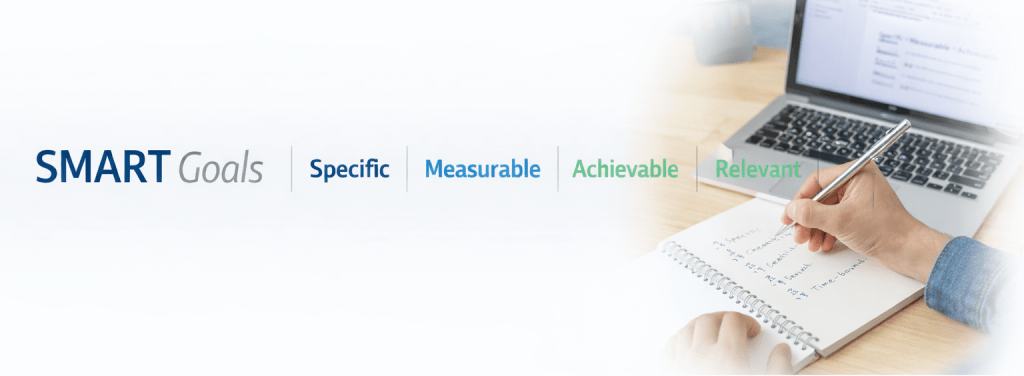
Students set a personal SMART goal (Specific, Measurable, Achievable, Relevant, Time-bound), tracked their progress in a shared document, and reflected on their learning at the middle and end of both semesters.
It became clear relatively quickly that motivation did not necessarily translate into action. At the start, most students were positive about setting goals, but maintaining consistent effort was much harder. Some students followed through, but many struggled to build regular study habits. As one student put it: “Actually, I was lazy. I played games instead of studying.”
One of the major issues was time management. As the semester progressed, students were dealing with assignments from other classes, part-time jobs, and extracurricular activities. In that context, independent study was often pushed aside. Goals that worked best tended to be small and flexible. For example, watching short videos or using vocabulary apps during spare moments was more sustainable than larger plans.
Reflection on their achievements was another challenge. Although many students did some kind of English study, they did not always record it. Logs were often left incomplete or written just before deadlines. This suggests that reflective practices do not come naturally to many students and need to be taught and supported more explicitly.
Despite this, there were also some clear positives. When students chose their own activities, they explored a wide range of options: YouTube, podcasts, apps, test preparation materials, and even using English at part-time jobs. Some adjusted their goals during the semester, suggesting a growing awareness of what worked for them. A number of students engaged consistently with the project, logged their activities in detail, and were able to see clear improvement in their language ability.
One clear takeaway is that learner autonomy does not develop on its own. Even setting a useful goal requires support and feedback, as students need help making their goals specific, realistic, and manageable. Ongoing support is also important to help students stay on track.
Despite my initial hopes, the project did not transform students into fully independent learners. However, it did encourage them to identify areas they want to improve and to think more carefully about how they study and what they are trying to achieve. Overall, this feels like a useful starting point.
If I run something similar again, I would:
provide more support when students first write their goals
show clearer examples of effective reflection
encourage smaller goals that fit into daily routines
Even small adjustments like these may help students turn good intentions into more consistent action
On Sunday, February 22nd, I attended the Kyushu ELT Convention at Seinan Gakuin University Fukuoka. I attended partly for professional development, but also to establish new connections in the area following my recent move to Fukuoka. This year was particularly notable as Fukuoka JALT hosted a room at the convention for the first time. The JALT team were friendly and professional throughout the day, and as an unexpected bonus, presenters received a refunded entry fee and lunch, which was very much appreciated.
I began the day by kicking off the JALT-hosted sessions with a short talk on educational podcasting. The session focused on practical reasons for starting a podcast and some technical considerations when launching one. There were several questions afterwards, so hopefully a few attendees may feel encouraged to try podcasting themselves.
The following session was delivered by Andrew McMahon (Fukuoka University), who discussed his experiences using the GELT-informed coursebook Global Activator. Drawing primarily on Rose and Galloway’s work (2019), he evaluated how well the textbook aligns with Global Englishes Language Teaching principles. His overall conclusion was positive, although he noted the need for greater representation of lexicogrammatical variation and less emphasis on static cultural groupings.
After lunch, Samuel Taylor (Kyushu Sangyo University) presented research on learner beliefs and classroom practice. His studies suggested that while students value English, many report low confidence—particularly in speaking tasks such as debates and presentations. The findings led him to propose four curriculum design principles, each of which he fleshed out with concrete classroom activity examples. He also outlined several possible future research avenues to investigate whether these design principles are effective in practice.
Next, Ayumi Shindo (ULU International) presented on creating connections beyond the classroom through nature-based learning with young learners. Although my main teaching context is tertiary education, it was interesting to see how she fosters motivation and creativity through non-competitive, outdoor-focused activities. The session prompted lively audience discussion about children’s play and screen use.
Ian Dagnall (Kyushu Sangyo University) then looked at the analysis of an e-learning vocabulary test. He noted that courses are often designed first, with the assessment effectively tacked on at the end and not always revisited. Instead, he argued for a more reflective approach where test data feeds back into needs analysis and course development. Using examples from his institution, he showed how statistical analysis can help evaluate test effectiveness and track student progress. Overall, it was a helpful reminder that assessment should play an ongoing role in course design rather than being a one-and-done component.
Following this, Robinson Fritz explored motivation in the language classroom using the metaphor of crossing a river with shifting currents. He framed motivation as dynamic and emotionally complex, introducing a linguacultural perspective and suggesting the use of a motivation profiler to track learner engagement over time. The session highlighted how learners can experience both positive and negative pulls simultaneously, and it prompted useful reflection on how we interpret changing motivation in our classrooms.
The final presentation, by William Pellowe, introduced ways to create listening materials using AI tools, particularly Typecast.ai. He demonstrated how text-to-speech voices and AI-generated dialogues can support listening materials development, especially for lower-level learners. As someone who has experimented with similar tools such as murf.ai, I found it useful to see an alternative platform in action.
Overall, it was a worthwhile day for connecting with the local ELT community in Fukuoka and hearing a range of perspectives on teaching and learning. Many thanks to the organisers and to Fukuoka JALT for hosting the room.
One of the main parts of my current job involves teaching academic writing to second-year Japanese students who are studying English. The students are tasked with writing a five-paragraph argumentative position paper on a specified theme, and they have no choice about the topic. The essay involves presenting their argument clearly, while also refuting the arguments of the other side. For example, students might take a position on the use of nuclear power, either for or against, and then present their case, followed by a refutation of the opposing side’s arguments.
As you can imagine, this kind of essay writing is quite a tough ask of young adults working in a foreign language. Whilst over the years I’ve been teaching, there have been clear improvements in some areas of student writing, progress has been uneven. For example, the adoption of Google Suite and Google Docs has largely eliminated many surface-level grammatical errors, but the use of sources to support claims within essays remains a persistent challenge.
It is difficult to put a precise number on what constitutes enough citations, but during the first semester the mean number of references per essay was 3.8. When giving feedback, one of my most common comments related to missing citations. Despite clear instructional focus on the need for references, students often failed to use citations to support their claims or acknowledge the sources of their ideas. Conversations with students revealed that, although they understood why citations were necessary, the time required to research and back up points was, to say the least, somewhat arduous.
Since all students were writing essays on the same theme, I decided to try a different approach at the start of the second semester and asked students to share their sources before writing. As homework at the start of each topic unit, each student researched online sources related to the essay theme. They were required to briefly summarise the information they found in simple English.
In the following class, students discussed what they had found, what kind of information it was, whether general background, pro, or con, and whether they thought it was useful for their essay and why. After these discussions, students pasted their research into a shared class document that everyone could access. They were then free to use any of their classmates’ sources when writing their essays.
The results were quite impressive. All students increased the number of references they used compared to the first semester. By the third essay, the mean number of references had risen to an average of around 6.1 per essay. This was a notable increase. Importantly, this increase was not driven by a small number of students using far more references, but reflected a general rise across the whole class.
At the end of the semester, I asked students to reflect on the usefulness of the sharing exercise by writing a short reflective paragraph during the final class. Students highlighted several benefits. They felt the activity saved time, strengthened their arguments, and gave them access to a broader range of information than they would have found on their own. Many also mentioned that seeing their classmates’ perspectives before writing helped them think more deeply about the topic. The only real drawback noted was that some arguments gleaned from the shared document were repeated frequently in other classes, such as debate class.
I think the combination of quantitative data, specifically the increase in the number of references used, and qualitative student comments makes a fairly strong case for this being a successful intervention. That said, there are some limitations worth acknowledging. This was a small-scale action research project involving just 30 students, and other factors may have contributed to the improvement. These include conceptually easier topics or students gradually becoming more aware of academic writing requirements. It is also possible that my repeated reminders about reference numbers simply took until the second semester to sink in. Overall, though, I consider this a success.
As a final addendum, it is difficult to write about academic writing, or writing done outside the classroom, without mentioning the massive game changer that is AI. Last year, I felt fairly confident in spotting fabricated AI-generated references. However, recent iterations of ChatGPT have become increasingly sophisticated at producing accurate reference lists and in-text citations. I also noticed that some students were using AI to summarise articles for them, which was not quite what I had hoped for. Still, technology moves on, and this is clearly something I will need to think about more carefully in future iterations of the course.