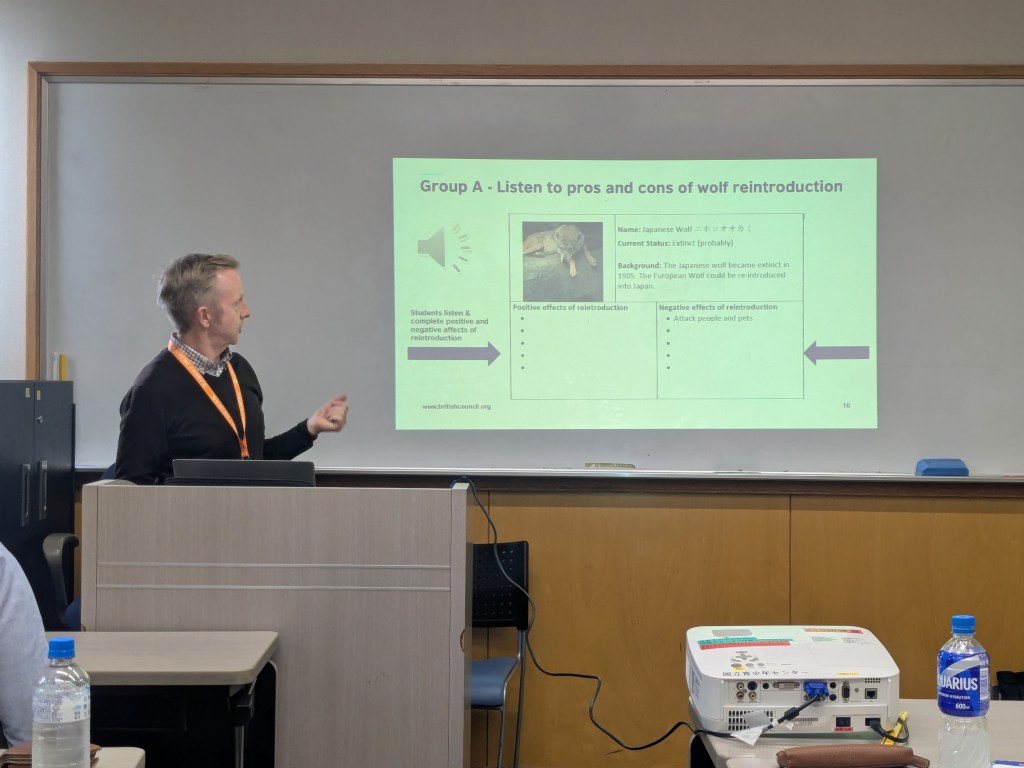
I was really pleased to be able to talk about jigsaw listening at the recent JALT International Conference in Tokyo. I’ve been increasing the use of these tasks in my classes, and it was a great opportunity to share my experiences with an audience of peers at the joint Listening SIG and Materials Writers SIG Forum.
Jigsaw listening is an information gap activity where students listen to different audio clips related to a topic, then share what they’ve learned in order to complete a task. I shared an example I’ve used in class where students listen to audio about four different extinct animals, exchange information, and then decide which of the four should be reintroduced.
I highlighted the benefits of jigsaw listening, especially how it promotes active listening. Rather than just listening passively, learners have to do something with the information they gather. First, they share it with their peers, then they examine it critically to reach a decision. It encourages peer-to-peer interaction, note-taking skills, and collaboration. I’ve found these activities to be engaging for students, and I’ve also noticed that they can almost teach themselves. Once the task is set up, it’s nice to be able to step back and watch the process unfold.
Jigsaw listening isn’t without its challenges, though. Because it’s a multi-stage procedure, it takes up considerably more class time than traditional listening exercises. Students are often not used to being this active during listening tasks, and it takes time for them to adjust to the format. Background noise can also be an issue, especially when multiple audio files are being listened to at the same time, although this can be mitigated with headphones. Using AI to write scripts and generate audio has helped reduce preparation time, but creating materials still requires care and thorough checking. Making sure the materials are level-appropriate is also a challenge, though tools like VocabKitchen can help with vocabulary checking.
My overall message was that if you’re willing to put in some effort up front, the rewards are worth it. You get an engaging, interactive lesson with lots of opportunities for collaboration and communication.
 Richard Ingham