Six Years of Podcasting: What I Learned From Creating a Student‑Focused Show

When I made my first recording with a student about her study abroad experiences, I had no idea that it would grow into a six-year project involving more than 170 episodes. What started as a small experiment eventually developed into one of the most rewarding parts of my teaching life.

What the Podcast Is

The podcast is aimed at the university-aged students in my department. It includes a mixture of short monologues, conversations between two people, interviews with students and staff, and occasional videocasts recorded by students. Topics cover culture, language tips, study abroad, and university life. We now have twelve seasons, with around 180 publised episodes available on Spotify.

Why I Started

When I launched the podcast in 2019, I felt our curriculum was heavily focused on reading and writing, but offered limited listening practice. Although we had intensive listening tasks in class, I wanted something that students could listen to extensively and informally outside class.

The timing also played a role. The podcast began at the start of the coronavirus pandemic, which removed many opportunities for casual interaction. It offered students a way to hear teachers and classmates speak naturally at a time when we couldn’t have classes together. Students returning from study abroad had stories worth sharing, and this gave them a voice.

There was also a professional development aspect for me. Learning how to create and distribute a podcast felt valuable and directly relevant to teaching in the digital age.

What I Learned

Starting a podcast is far simpler than many people imagine. I used Anchor (now Spotify for Creators), and it handled hosting and distribution for free. For a small, niche podcast like ours, it worked perfectly.

The equipment does not need to be sophisticated. Although I bought a condenser microphone, pop-shield and audio interface, I ended up recording most episodes using the microphone on my iPad or iPhone. Editing was typically limited to trimming the beginning and end of the audio in GarageBand.

Production gets faster with experience. Once I had a system, I could record a five‑minute episode in under twenty minutes. I wrote rough scripts early on, but AI has made drafting much quicker in recent years.

Topic choice matters. Popular themes included pop culture, British culture, language tests, brand histories, and language tips. The most listened‑to episodes by far were interviews with students about their study abroad experiences. Over time, these have been integrated into our study abroad preparation courses, helping students learn from real voices and real situations..

Student involvement is powerful, even if difficult to coordinate. Students rarely volunteered, but almost all who participated felt proud afterwards. I would have liked more student‑generated content, although managing this takes more time.

The Future

Recently I experimented with videocasts since Spotify now supports video. I expected this to be more appealing since many students are heavy YouTube users. Surprisingly to me, the listener numbers did not change. It may be that Spotify may not be the best place for video. Perhaps if the videocasts were uploaded to YouTube, they might attract more engagement. In addition, video production takes significantly longer than producing audio‑only episodes. Even short clips require much more editing time, and this extra workload is difficult to justify for a small, niche project.

Looking ahead, I am aware that AI-generated podcasts are becoming more common. High‑quality automated content will likely fill podcast platforms in the near future. Even so, I believe there will always be a place for authentic student voices. Real experiences and real conversations have a value that AI cannot replace. Whatever direction the project takes, it has been a meaningful part of my work, and I hope it continues to provide students with something useful.

Link the podcast is here:

https://open.spotify.com/show/04UyCI0pyvJi6LBVr1QBRo


Jigsaw Listening: Listen, Share, Decide.

I was really pleased to be able to talk about jigsaw listening at the recent JALT International Conference in Tokyo. I’ve been increasing the use of these tasks in my classes, and it was a great opportunity to share my experiences with an audience of peers at the joint Listening SIG and Materials Writers SIG Forum.

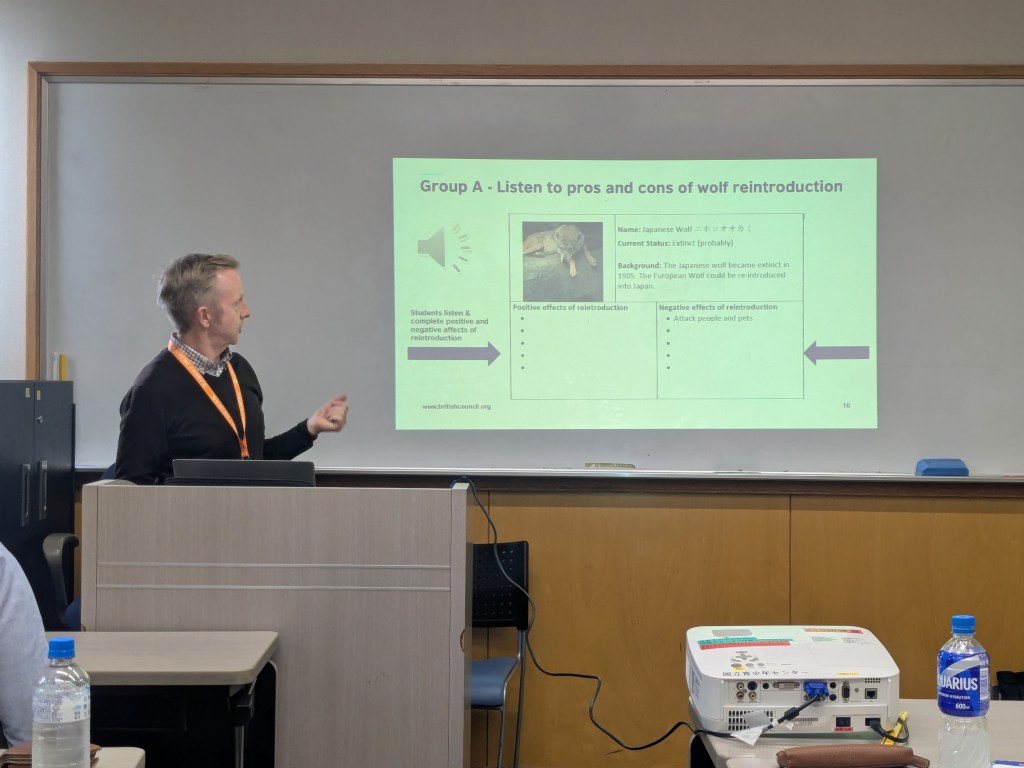
Jigsaw listening is an information gap activity where students listen to different audio clips related to a topic, then share what they’ve learned in order to complete a task. I shared an example I’ve used in class where students listen to audio about four different extinct animals, exchange information, and then decide which of the four should be reintroduced.

I highlighted the benefits of jigsaw listening, especially how it promotes active listening. Rather than just listening passively, learners have to do something with the information they gather. First, they share it with their peers, then they examine it critically to reach a decision. It encourages peer-to-peer interaction, note-taking skills, and collaboration. I’ve found these activities to be engaging for students, and I’ve also noticed that they can almost teach themselves. Once the task is set up, it’s nice to be able to step back and watch the process unfold.

Jigsaw listening isn’t without its challenges, though. Because it’s a multi-stage procedure, it takes up considerably more class time than traditional listening exercises. Students are often not used to being this active during listening tasks, and it takes time for them to adjust to the format. Background noise can also be an issue, especially when multiple audio files are being listened to at the same time, although this can be mitigated with headphones. Using AI to write scripts and generate audio has helped reduce preparation time, but creating materials still requires care and thorough checking. Making sure the materials are level-appropriate is also a challenge, though tools like VocabKitchen can help with vocabulary checking.

My overall message was that if you’re willing to put in some effort up front, the rewards are worth it. You get an engaging, interactive lesson with lots of opportunities for collaboration and communication.

JALT 2025 Study Abroad Conference Reflection

The JALT Study Abroad SIG conference was held at Kinjo Gakuin University on October 18th, 2025. Although study abroad (SA) is not my main research focus, I decided to attend for several reasons. Firstly, I teach an intensive SA preparation course for students heading to Australia for a month in spring, and I was hoping to learn something new to support them. Secondly, along with my colleague Tom (who was also in attendance), I often interview students who have returned from SA so they can share their experiences via our departmental podcast. Thirdly, the conference was conveniently held in Nagoya, where I’m based, so travel was easy. And finally, for someone without a research budget, the fee of just 2,500 yen represented excellent value compared to other conferences (I’m looking at you, JALT International Conference).

As hoped, I came away with several new ideas for my preparation course. Gregory Minehan’s presentation encouraged me to think about how students could get more out of their homestay experiences. He shared feedback from host families about what makes a good homestay student. Following his talk, I began to consider ways to support students in their interactions with host families, perhaps through small-talk dialogues or roleplays to build confidence.

Similarly, Morgen Livingston’s presentation inspired an activity idea: giving students practice in explaining unique aspects of Japanese culture to others. He pointed out that topics like anime and sushi are already familiar to most people, so encouraging students to introduce something less well-known could make for more engaging cultural exchanges.

Although not her main focus, part of Yukie Saito’s presentation addressed the financial realities of studying abroad. With the weak yen and rising prices, even basic items can be surprisingly expensive abroad (for example, 300 yen for a bottle of water compared to 100 yen in Japan). I thought it might be helpful to highlight this before departure and have students brainstorm cost-saving strategies such as packing lunches or shopping at supermarkets.

Throughout the day, several speakers also highlighted how the experiences of returning students can support those preparing for study abroad. I was espcecially pleased to hear that because it confirmed the value of the recordings I’ve made for our departmental podcast, where returnees share their stories and advice. I also came to realise that these conversations are valuable not only for students preparing to go abroad but also for those who have already returned. They provide an opportunity for reflection and help students continue their English learning journey, something I hadn’t previously considered. It made me even more motivated to keep producing podcast episodes featuring our students’ voices.

As a relative newcomer to study abroad, I also learned about funding opportunities. Firstly, I learned about support available through JASSO. It seems that for faculty members willing to do the paperwork (or collaborate with administrative staff), there may be opportunities to secure funding for study abroad programs. In addtion, I also heard discussions about Tobitate scholarships available for individual students. Many of our students are eager to go abroad but struggle with funding, so these could be promising options to explore..

One presentation also introduced the newly established Study Abroad Research Group (SARG), an initiative aimed at encouraging collaboration between researchers to share resources, broaden datasets, and mentor members with less research experience. Although this is not an area I plan to get involved in personally, it struck me as an excellent idea and a valuable way to strengthen research networks within the study abroad community. I hope it proves to be a great success.

The poster sessions offered opportunities for informal conversations with presenters, which I really enjoyed. It was great to chat with students who had returned from study abroad and hear how the experience had changed them. It also looks like we’ve lined up some future podcast guests, thanks, Tom!

All in all, it was a great conference, and I’m really glad I went. A big thank-you to the organisers for putting together such an engaging and informative event.

Why Write Conference Reflections?

Starting this blog has made me think more carefully about my professional writing. As part of setting up this WordPress site, I gathered a list of my publications to show what I’ve worked on so far. It seemed useful to have everything in one place and easy to update.

As I went through the list, I noticed something interesting: quite a few of my publications were conference reviews or reflections. I think there are five so far, and there may well be more to come.

That got me thinking. Is that too many? Is it worth writing up your thoughts on conferences? After some reflection, I believe there are several good reasons to do so:

1) Publications

“Publish or die” is a familiar saying in academia. Writing a conference review can be a relatively straightforward way for early-career or novice writers (a group I still consider myself part of) to gain experience with academic publishing and build up a CV.

Some outlets, such as the JALT Teacher Development SIG’s Explorations in Teacher Development, go through a peer-review process. If you choose your target publication carefully, your reflection can even count as a peer-reviewed piece, adding genuine value to your academic record.

2) Money

For teachers without access to institutional research budgets, writing a conference review can also open doors to small grants or travel support. Some JALT SIGs, such as CUE (College and University Educators), offer financial assistance in exchange for a review. Similarly, some conferences, like PANSIG, have funding available for participants who are willing to write about their experiences.

3) Reflection

Many people attend conferences to give a presentation, meet colleagues, or fulfil professional obligations. Writing a review encourages a different kind of engagement. It pushes you to think carefully about what you’ve seen, reflect on key ideas, and consider how they might connect to your own teaching or research. That process of reflection can sometimes lead to unexpected insights that benefit both you and your learners.

Writing a review also takes real effort. Staying focused throughout a full day, or even several days, of presentations is not easy. It demands concentration, strong note-taking skills, and good organisation to make sense of multiple topics and speakers. It can be hard work, but the discipline it requires often makes the experience more rewarding.

4) Connection (Networking)

Writing a review can be a good way to strengthen professional connections. You might contact someone whose presentation you mentioned, share your write-up with them, or tag them in a LinkedIn post. It’s a genuine and positive way to build relationships, and most presenters appreciate hearing how their ideas were received.

5) Promoting Local / Smaller Conferences

Across Japan, there are conferences happening almost every week, and smaller or more specialised events can sometimes be overlooked. Organising a conference takes a huge amount of time and commitment. While most people know the larger gatherings, such as JALT National or PANSIG, smaller events also deserve recognition.

One of my recent pieces was about the FSIJ (Film Studies In Japan) conference, and the organiser was genuinely pleased that I had taken the time to write about it. It was clear that the event had taken a great deal of effort to organise, and I was happy to help highlight that work.

Other reasons?

You could also add that writing conference reflections helps consolidate learning, contribute to the professional community, and build your online presence. But I think my list of five is enough for now.

Final thoughts

Conference reflections may not be the most glamorous form of academic writing, but they combine many valuable skills: critical thinking, synthesis, communication, and reflection. They also give back to the professional community by sharing ideas and highlighting others’ work.

I plan to continue reflecting on my conference experiences here on the blog, though perhaps it’s time to encourage others to share their own perspectives as well. After all, the more voices we have reflecting on professional learning, the richer our community becomes.

Reflections on Teaching English in Japan

Hello, and welcome.

After many years of teaching English, most of them in Japan, I decided to start this site as a place connected to my work and interests.

I also want this site to act as a record of the things I am doing. Teaching, mentoring, podcasts, projects, events, and extracurricular activities often pass quickly, and I think it is useful to capture them in one place. In the same way, brief notes here may grow into something more substantial later, such as a book review, article, or even a future publication.

My hope is that, over time, this space will not only help me to develop but also provide something of interest to colleagues, prospective employers, or anyone curious about the teaching of English in Japan.

Thank you for visiting, and I hope you find something here worth reading.